Transfer of Shares – ROC & Statutory Compliance in India
Transfer of Shares under Companies Act, 2013
Share Transfer starting at ₹2,999 + GST & Govt Fees
Transfer of shares refers to the voluntary transfer of ownership of shares by an existing shareholder to another person. In India, share transfer is governed primarily by the Companies Act, 2013, the company’s Articles of Association (AOA), and applicable stamp duty laws.
A share transfer becomes legally valid only after proper documentation, payment of stamp duty, Board approval, and updation of statutory records.
Let our experts handle your share transfer documentation, Board approvals, and compliance records smoothly and professionally.
Transfer of shares means the voluntary shifting of ownership of shares from one shareholder (transferor) to another (transferee). After completion, the transferee becomes the legal shareholder entitled to voting rights, dividends, and other ownership benefits.
A share transfer is not automatic. It is effective only when:
o Transfer deed is properly executed
o Stamp duty is paid
o Board of Directors approves the transfer
o Company updates its statutory registers
Who Can Transfer Shares?
Not every person can transfer shares. Only existing shareholders of a company have the right to initiate a share transfer. The ability to transfer may also depend on the type of company (private or public) and any restrictions mentioned in the company’s Articles of Association (AOA).
Eligibility to Transfer Shares :
Existing Shareholders: Only a person already holding shares in the company can transfer them.
The person receiving the shares (transferee) must be eligible to hold them under the company’s Articles of Association and applicable law.
Private Limited Companies : Transfers are often restricted, requiring:
o o Consent of other shareholders (Right of First Refusal)
o o Board approval
Public Limited Companies : Generally, shares are freely transferable, except when restricted by law or AOA.
When Share Transfer Can Occur
A shareholder may choose to transfer shares under several circumstances:
Sale or Exit: Selling shares to another investor or exiting the company.
Gift to Family or Friends: Shares may be gifted, subject to compliance with Articles and stamp duty.
Internal Restructuring: Changing ownership within a company for business or strategic reasons.
Transmission by Legal Heir: When shares are passed due to death or succession (though technically called “transmission,” not voluntary transfer).
Need help? Let Our Experts Guide You
You focus on growing your business — we’ll handle the legal compliances and regulatory complexities
The transfer of shares in India is primarily governed by the Companies Act, 2013, the company’s Articles of Association (AOA), and certain rules framed by the Ministry of Corporate Affairs (MCA). Understanding these provisions is critical to ensure a valid and legally compliant share transfer.
1. Section 56 – Transfer and Transmission of Securities
Applicability: Applies to both private and public companies.
Key Points:
o Any transfer of shares must be executed in writing through a proper Share Transfer Form (Form SH-4).
o The form must be stamped appropriately before submission.
o The company is required to register the transfer in the Register of Members within the prescribed time.
Practical Tip: SH-4 is mandatory for both sale and gift of shares.
2. Section 58 – Refusal of Registration of Transfer
Purpose: Allows a company to refuse registration of share transfer under specific circumstances.
Key Conditions:
o If the transfer does not comply with AOA restrictions.
o If the transferee is not legally eligible to hold shares (e.g., minor in some private companies).
o If stamp duty has not been paid or documentation is incomplete.
Timeframe: If the company refuses registration, it must inform the transferee within 30 days of the refusal.
3. Rule 11 – Companies (Share Capital and Debentures) Rules, 2014
Objective: Prescribes procedural requirements for share transfer, including:
o Submission of transfer deed (SH-4)
o Board approval for registration
o Updating statutory registers and records
Importance: Ensures that all share transfers are transparent, legally enforceable, and properly documented.
4. Articles of Association (AOA) Restrictions
Private companies often include restrictions on share transfers in their AOA, such as:
o Right of First Refusal (ROFR): Existing shareholders have priority to buy shares before external parties.
o Consent of Board or shareholders: No transfer can occur without approval.
Why it matters: Any transfer in violation of AOA may be rejected by the company and deemed invalid legally.
5. Stamp Duty and Payment Compliance
Under the Indian Stamp Act, stamp duty must be paid on the transfer deed (SH-4) before registration.
Rates:
o Private Limited Company : – 0.25% of the consideration or market value
o Public Limited Company (listed) : – 0.015% of the consideration or market value
Implication: Non-payment of stamp duty may invalidate the share transfer, even if all other formalities are completed.
6. Practical Compliance Checklist
o Execute Form SH-4 with proper stamping
o Obtain Board approval for registration
o Verify eligibility of transferee under AOA
o Update Register of Members
o Issue new share certificate to the transferee
Documents Required for Transfer of Shares
Share Transfer Deed (Form SH-4)
Original Share Certificate
Board Resolution approving transfer
PAN and address proof of transferee
Stamp duty payment proof
Updated Register of Members
Step-by-Step Process for Transfer of Shares
Step 1
Execution of Share Transfer Deed (SH-4)
• SH -4 needs to be executed by both transferor and transferee
• Stamp duty to be paid as applicable
Step 2
Submission to Company
• SH-4 and original share certificate to be submitted
• Must be submitted within 60 days from the date of execution
Step 3
Board Approval
• Board reviews documents
• Passes resolution approving transfer
Step 4
Updating Statutory Records
• Register of Members updated
• Old share certificate cancelled
Step 5
Issuance of Share Certificate
• New share certificate issued to transferee
• Within 30 days of Board approval
Stamp Duty on Transfer of Shares
Stamp duty is a mandatory legal requirement for the validity of any share transfer. It is calculated on the consideration amount or market value of shares, whichever is higher, and must be paid before submitting SH-4.
📌 Important Notes:
Rates may vary slightly between states as per State Stamp Acts
Stamp duty is mandatory even for gift of shares
Non-payment may invalidate the share transfer legally
Typical Stamp Duty Rates Across India
Type of Company
Stamp Duty Rate
Private Limited Company
0.25% of consideration or market value
Public Limited Company (listed on stock exchanges)
0.015% of consideration or market value
Need help? Let Our Experts Guide You
You focus on growing your business — we’ll handle the legal compliances and regulatory complexities
A shareholder may transfer shares as a gift, commonly to family members. Even without monetary consideration, gift of shares is treated as a valid transfer under Section 56 of the Companies Act.
Eligibility to Transfer Shares :
Execution of Form SH-4
Payment of stamp duty on market value
Compliance with Articles of Association (AOA)
Board approval
Update of Register of Members
Note: A gift of shares without stamp duty or Board approval is not legally valid.
Transmission of Shares
Transmission of shares occurs by operation of law, e.g., death, insolvency, or inheritance. Unlike a transfer:
No SH-4 is required
No stamp duty is payable
Documents Required
Death certificate (if applicable)
Succession certificate / probate / will
Indemnity bond
KYC of legal heir
Board resolution approving transmission
Process of Transmission
1. Submission of transmission request by legal heir
2. Verification of documents by company
3. Board approval
4. Entry of legal heir in Register of Members
3. Board approval
Lost / Missing Share Certificate
Even if the shareholder does not have the original certificate, transfer or transmission can proceed after additional compliance:
Procedure:
Filing of affidavit by shareholder
Execution of indemnity bond
Newspaper advertisement (if required)
Board approval for duplicate certificate
Issuance of duplicate certificate
Proceeding for Transfer or transmission thereafter
Note: A share transfer cannot be registered without a valid or duplicate certificate.
Transfer of shares Vs Gift Vs Transmission
Particulars
Transfer
Gift
Transmission
Nature
Voluntary
Voluntary (without consideration)
By operation of law
SH-4 Required
Yes
Yes
No
Stamp Duty
Applicable
Applicable
Not applicable
Common Cases
Sale / exit
Family transfer
Death / succession
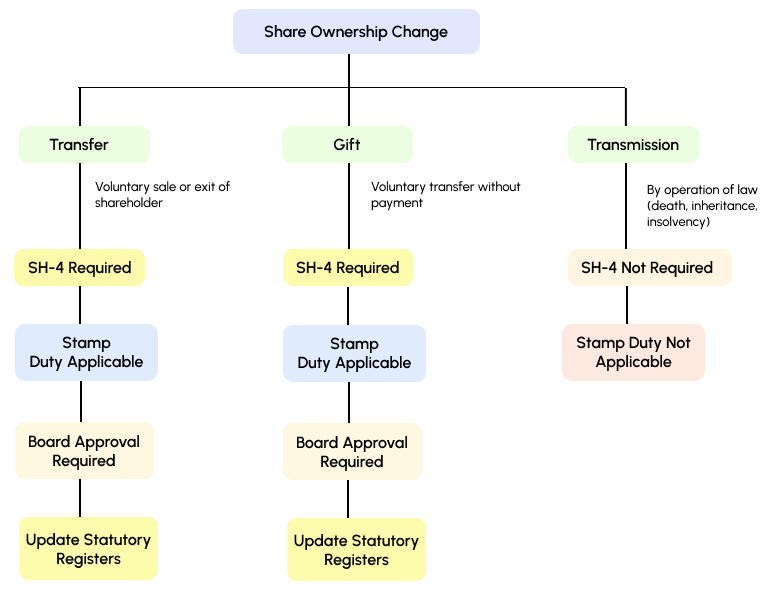
Flowchart: Transfer of Shares – Transfer vs Gift vs Transmission
Time Limits for Share Transfer
Activity
Time Limit
Submission of SH-4
Within 60 days from date of execution
Issue of Share Certificate
Within 30 days of approval of share transfer
Need help? Let Our Experts Guide You
You focus on growing your business — we’ll handle the legal compliances and regulatory complexities
Penalties & Compliance Risks of Improper Share Transfer
Failure to comply with stamp duty and share transfer requirements can lead to serious legal and commercial consequences. Some key risks include:
1. Transfer May Be Treated as Invalid
If the share transfer deed (Form SH-4) is not duly stamped or properly executed, the company may refuse to register the transfer. In such cases, legal ownership of shares does not pass to the transferee, making the transfer legally unenforceable.
3. Issues during Audits or Due Diligence
Unstamped or improperly documented share transfers are frequently flagged during:
Statutory audits
Secretarial audits
Investor or acquirer due diligence
Such lapses can delay transactions, impact company valuation, or even lead to deal renegotiations or cancellations.
2.Shareholder Disputes
Improper or non-compliant transfers can result in conflicting ownership claims, especially during voting, dividend declarations, or exit events. This often leads to disputes between shareholders, promoters, or investors and may require legal intervention to resolve.
4. Non-Compliance under the Companies Act, 2013
Non-payment of stamp duty or failure to follow prescribed share transfer procedures may result in regulatory non-compliance under the Companies Act, 2013 and applicable Stamp Acts. Companies and officers in default may face:
Monetary penalties
Regulatory scrutiny
Adverse remarks in secretarial or compliance reports
FAQs – Transfer of Shares (SEO-Friendly)
Thinking of starting your business in India? Below are the most common questions about Private Limited Company registration — from documents to compliance and timelines.